Why You Pick Up Choreography Faster Standing at the Back
Quick Answer: At the back you can see the instructor, the mirror and several other people’s bodies at once, which gives you multiple simultaneous references and lets you correct against the group rather than against your own reflection. Front-row learners get a better view and worse feedback. Once you know the routine, move forward — the front is better for performance quality and worse for acquisition.
The keen students take the front row. The people who actually learn the combination fastest are frequently two rows behind them.
This is not modesty or avoidance. It is about how much visual information you can take in at once, and the back genuinely gives you more of it.
What is actually different about the view from the back?
Three things, and they compound.
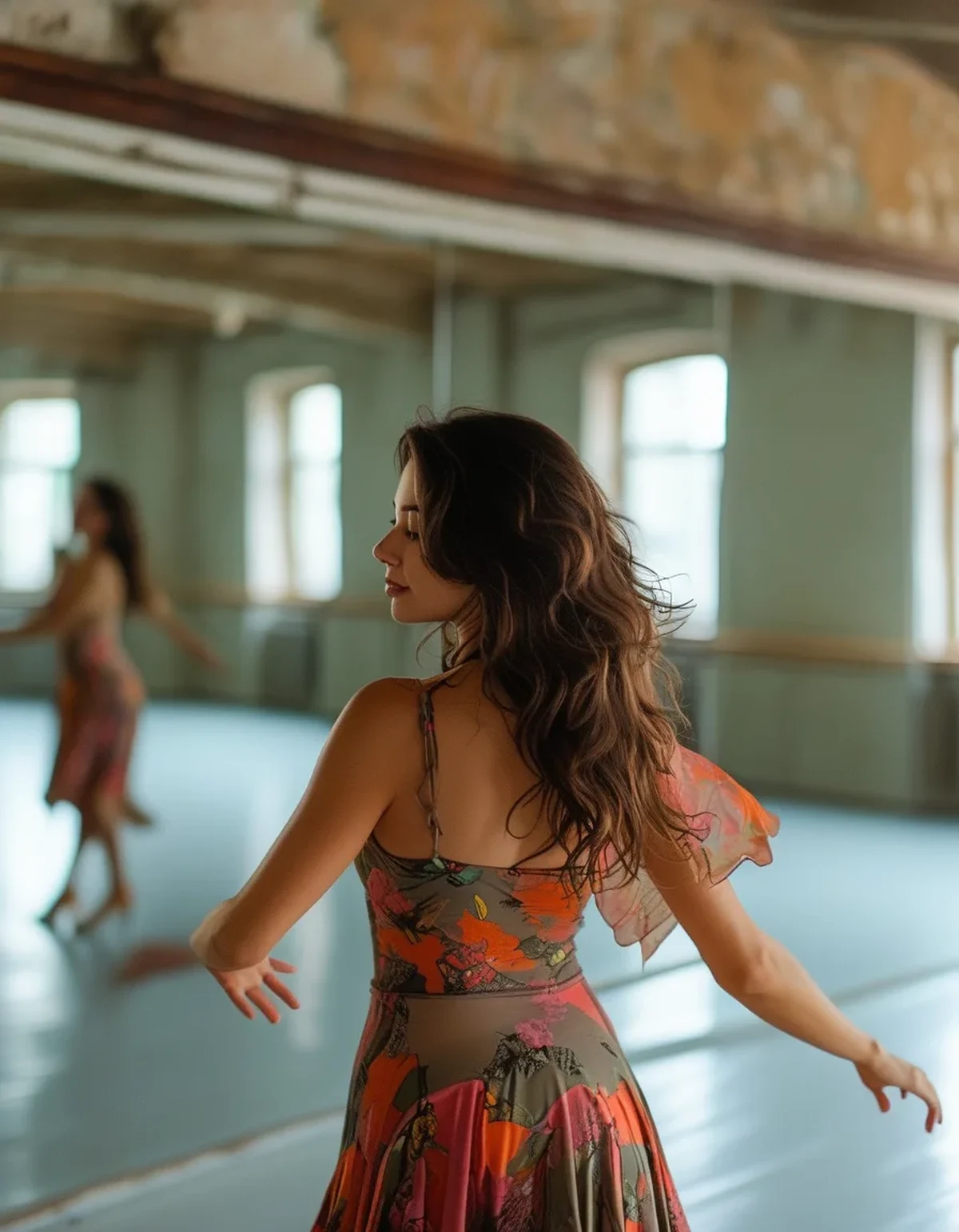
You see multiple bodies doing the same thing. In the front row you have the instructor and your own reflection. Two rows back you have the instructor, your reflection, and eight other people. Your brain is very good at extracting a common pattern from multiple noisy examples — considerably better than it is at copying a single example precisely. The average of eight people doing the move is a cleaner signal than any one of them individually.
You get the timing from the room, not just from the count. Movement is contagious in a very literal sense; being surrounded by people moving on the beat entrains your own timing. From the front you have nobody in your peripheral vision, so you are relying entirely on the music and the count.
You can look without being looked at. This matters more than people admit. The front row is aware of being watched, and self-consciousness consumes attention. Attention is exactly the resource that learning a new pattern requires, and there is not much of it to spare.
There is a fourth, more practical benefit: at the back you can mark a section — do it small and low-energy while you work out what it is — without feeling that you are visibly not keeping up. Marking is one of the most effective learning tools in dance and it is socially difficult in the front row.
Why does watching yourself in the mirror slow you down?
The mirror is the most misunderstood tool in the studio.
Watching your reflection while learning creates a feedback loop that runs at the wrong speed. You do the move, you look, you evaluate, you adjust — and by the time you have done that, the class is two counts ahead. The evaluation step is genuinely useful and it is genuinely slow, and during acquisition you cannot afford it.
It also reverses everything. Your reflection is mirrored, so left and right are swapped relative to what you see. Most people handle this without thinking about it, but under cognitive load — which is exactly what learning new choreography is — the reversal costs processing.
And it pulls your gaze to the wrong place. In most styles the correct focus is out and forward, and mirror-watching drops the gaze to your own body, which changes your posture and your balance.
The useful sequence: learn it looking at other people, refine it looking at the mirror, perform it looking at nothing. Most people do all three at once from day one and get the worst of each.
A specific tip that works remarkably well: for the first two run-throughs of a new section, deliberately do not look at the mirror at all. Watch the instructor and the person in front. You will feel less certain and you will retain more.
What about when you should move forward?
The back is better for learning. It is worse for almost everything else, so do not live there.
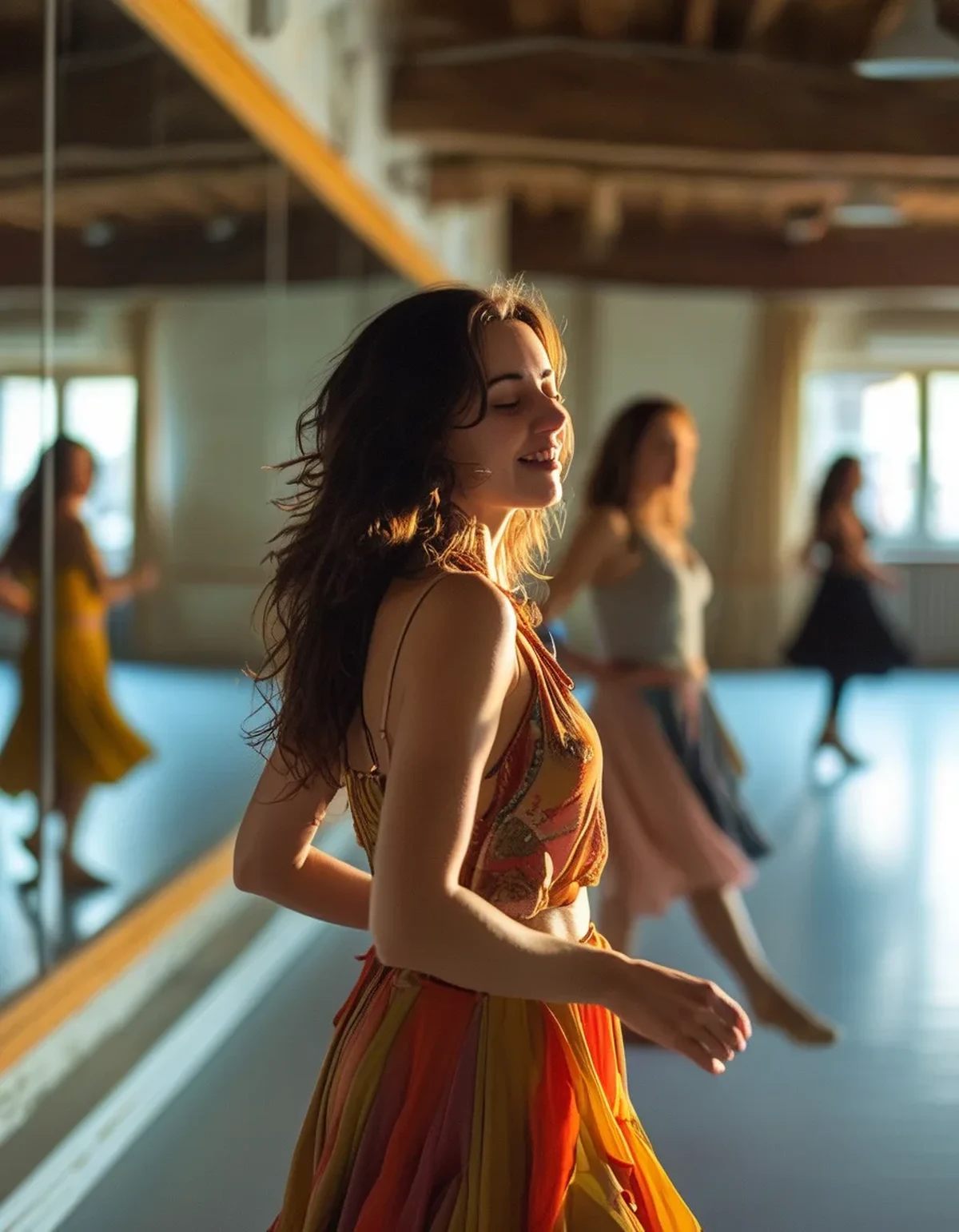
Move forward once you know the sequence. The front row is where you find out whether you are actually doing it, because you have nothing to copy and no one to hide the timing errors. This is uncomfortable and it is exactly the useful kind of uncomfortable.
Move forward for anything requiring precision of shape. Lines, extensions, arm positions — you need the mirror and you need it close.
Move forward if you have started drifting. A specific back-row failure mode is copying the person in front rather than the instructor, with a half-beat delay that becomes habitual. If you notice you are consistently just behind the group, you are following a follower.
And move around. Standing in a different spot each week is one of the most useful things you can do, because it prevents you from anchoring the choreography to spatial cues. A routine learned from one position in the room often falls apart when you perform it somewhere else, and that is a learning artefact rather than a memory failure.
A useful rule: back row for new material, middle for consolidation, front for the run-throughs at the end. Most classes are structured in those three phases anyway.
What nobody tells you about learning routines
Sleep does a large part of the work. Motor sequence consolidation happens during sleep, and the standard finding is that people perform a newly learned sequence better after a night’s sleep than they did at the end of the practice session. The combination you could not do on Tuesday is often available on Thursday without any practice in between, which is why giving up on a section at the end of a class is premature.
Verbalising the counts out loud helps early and hurts later. Counting recruits working memory to scaffold the sequence, which is exactly what you need at the start. Once the movement is becoming automatic, continuing to count interferes with it — this is the well-documented effect where conscious attention degrades an automated skill.
Learning the transitions is the whole game. Almost everyone can do the eight-count phrases in isolation and loses the routine at the joins. Practise the last two counts of one phrase and the first two of the next as a unit, and the routine assembles itself.
Filming yourself once is worth ten mirror glances. You see the timing and the shape from outside, without the reversal, and without the real-time evaluation loop. Once per routine is enough — it is a diagnostic, not a habit.
And variability beats repetition. Practising a phrase at three different speeds, or facing three different directions, produces better retention than the same number of repetitions done identically. It feels less productive at the time and it is not.
FAQ: Learning Choreography Questions, Answered
How many times do I need to see something before I get it?
Highly individual, but the pattern matters more than the count: watch it once without moving, mark it small twice, then do it full-out. Trying to do it full-out on the first exposure is what makes people feel slow at picking things up.
Why do I lose the routine the moment the music starts?
Because you learned it to counts and are now hearing something different. Ask for it to be run to music earlier and more often — the music is a memory cue in its own right, and a routine learned only to counting has no hooks in it.
Should I write the choreography down?
It helps a surprising number of people, particularly for order rather than execution. A short list of section names — grapevine, floor, turn sequence — is usually more useful than trying to describe the moves themselves.
I am the slowest in the class. Is that a problem?
Almost certainly not a permanent one. Picking up choreography quickly is a trainable skill built largely on pattern familiarity, and it improves with exposure to more styles rather than with more repetitions of one routine. The people who look fast have usually just seen more.
TL;DR:
- The back row gives you the instructor, the mirror and several other bodies at once — more reference signal, and freedom to mark.
- Mirror-watching during acquisition creates a slow evaluation loop and reverses left and right under load.
- Learn at the back, consolidate in the middle, run it at the front. Then change your spot every week.
- Sleep consolidates motor sequences, transitions are where routines break, and varied practice beats identical repetition.
If you have been standing at the front to prove you are trying, try two rows back for one class and see how much more you keep.
Keep Reading
This article is for general informational and styling purposes only. Fit, sizing, and product availability may vary.