Why a Song You Love Makes You Worse at Following Choreography
Quick Answer: A familiar song comes with a stored set of expectations about how you move to it, built up over years of listening. When the choreography does not match those expectations, your automatic prediction and the instructor’s actual movement compete for the same motor plan, and the conflict costs you processing time. Unfamiliar music has no stored template, so nothing competes. That is why you learn faster to a track you have never heard.
It feels like the song should help. In terms of learning new movement, it mostly interferes.
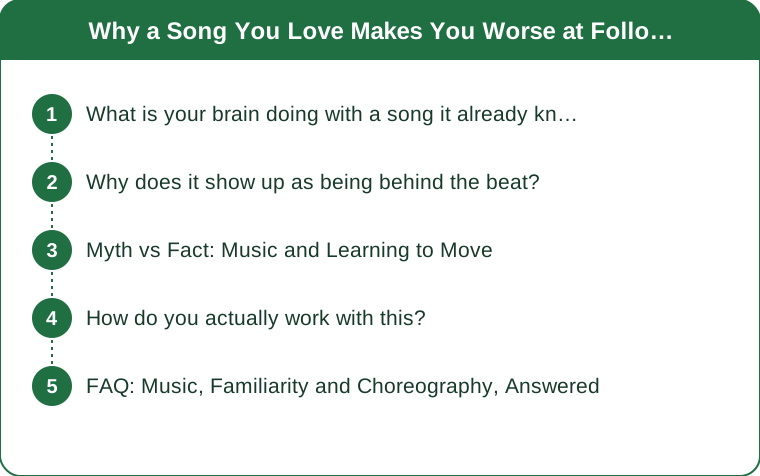
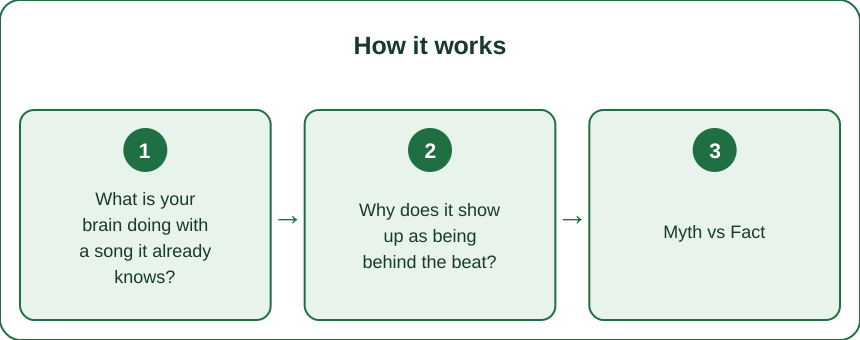
What is your brain doing with a song it already knows?
Listening to familiar music is heavily predictive. Your auditory system is not passively receiving the track, it is anticipating what comes next, and that anticipation is what produces the pleasure of knowing a song well.
Those predictions are not purely auditory. Music you know well is associated with stored motor patterns: how you have danced to it, how you have moved in a car or a kitchen, where you expect the emphasis to land, where you expect to move big and where to hold back. This is a real phenomenon and it is why hearing a familiar song produces an urge to move in a particular way rather than in any way.
When an instructor puts different choreography over that track, you now have two competing motor plans. One is automatic, stored, and cued powerfully by the music. The other is new, effortful, and cued visually from a screen or a person in front of you.
Resolving that conflict costs attention. The automatic plan does not politely stand aside; it has to be suppressed, and suppression is an active process that uses the same limited resources you need for learning the new sequence.
The result is that you are learning the routine while simultaneously inhibiting a well-established alternative, which is measurably harder than learning it with no alternative present.
Why does it show up as being behind the beat?
Because the timing predictions are the strongest part of the stored template, and timing is where the conflict shows.
With a familiar track, you know exactly where the chorus lands, where the drop is, where the bar structure shifts. Your movement wants to organise itself around those landmarks. If the choreography phrases differently, counting from a different point in the bar, or holding through a transition you expect to move on, your body arrives early or late relative to the class.
The correction then costs you a beat, and once you are a beat behind you are watching rather than moving, which puts you further behind. This is the cascade that people describe as falling apart on a song they know.
Unfamiliar music produces the opposite. With no stored expectation, you take your timing entirely from the instructor, which is the correct source. You are less certain, and you are also not fighting anything.
There is a second factor: emotional engagement. A song you love recruits attention toward the music itself. Enjoyment and focus on the audio are pulling processing away from the visual channel you need for copying movement. It is genuinely harder to watch closely while listening intently to something you love.
And familiar tracks encourage singing along, which is not free. Vocalising uses working memory and interferes with sequence learning, which is why people who sing through the routine are usually the ones who cannot remember it afterward.

Myth vs Fact: Music and Learning to Move
Myth: Music you love makes you perform better at everything. Fact: it reliably improves motivation, perceived exertion and endurance output. For learning a new motor sequence, it can interfere. Those are different tasks with different demands.
Myth: If you cannot follow, you have poor rhythm. Fact: most people who struggle on a familiar track follow unfamiliar tracks perfectly well. That is not a rhythm problem, it is an interference problem, and the fix is different.
Myth: Playing the routine song on repeat at home will help you learn it. Fact: listening without moving strengthens the auditory template without attaching the new movement to it, which can make the interference worse. If you practise at home, move while listening.
Myth: Slower songs are easier to learn to. Fact: tempo matters less than familiarity and phrase structure. A slow familiar song with strong stored associations can be harder than a fast unfamiliar one.
Myth: You should count out loud to fix it. Fact: counting out loud helps some people and it competes for the same verbal working memory that suppression is using. Many people follow better counting internally or not at all, feeling the phrase instead.
How do you actually work with this?
Learn new routines to unfamiliar music. If you are choosing your own classes, pick ones with tracks you do not know when the goal is learning. Save the songs you love for routines you already have.
Watch first, move second. One pass watching without attempting the movement builds the visual sequence before you introduce the conflict. It feels like wasted time and it is the fastest route through.
Break the association deliberately. If the instructor uses a track you know, spend the first pass consciously ignoring where you expect the emphasis to be and take every timing cue from the instructor. Naming the interference reduces it.
Stop singing along. The single easiest change, and the one that produces the largest immediate improvement for people who do it.
Use the familiar song for the part it is good at. Once you know the routine, running it to a track you love will produce better output, more effort and more enjoyment. Familiarity is an asset in performance and a liability in acquisition.
And do not fight it during class. If a track is derailing you, drop to a simpler version of the movement, hold the base step, and rejoin at the next phrase. Recovering the phrase is far more valuable than catching up mid-sequence, and it is what experienced dancers do automatically.
FAQ: Music, Familiarity and Choreography, Answered
Does this get better with experience?
Yes. Experienced dancers build the ability to take timing from an external source and suppress internal expectations, and it is a trainable skill rather than a talent.
Why do I learn faster in silence?
Because there is no competing template at all and no attentional pull toward the audio. Many instructors teach new sequences with the music off or very low for exactly this reason.
Should I avoid my favourite songs entirely?
No. Use them for sessions where the goal is intensity and enjoyment rather than learning. They genuinely improve output and reduce perceived effort.
Why is it worse in a mirror?
Mirrors add a spatial transformation on top, and the combination of mirror reversal plus competing timing expectations is the hardest case. Turning away from the mirror while learning helps a lot of people.
Does the same thing happen with routines I already know?
Rarely, because the routine has been attached to that track and the stored template now includes it. That is why a familiar routine to a familiar song is the easiest of all.
TL;DR:
- A well-known song carries stored motor and timing expectations that compete with new choreography.
- Suppressing that automatic plan uses the same attention you need for learning, so you fall behind.
- Familiar music also pulls attention toward the audio and encourages singing, which costs working memory.
- Learn to unfamiliar tracks, watch one pass before moving, and take every timing cue from the instructor.
- Use the songs you love for routines you already know, where familiarity is an advantage.
The song is not too fast and your rhythm is fine. You already knew how to move to it, and that is the problem.
Keep Reading
This article is for general informational and styling purposes only. Fit, sizing, and product availability may vary.