Why You Learn a Routine Faster When You Stop Counting Out Loud
Quick Answer: Counting out loud uses verbal working memory, which competes directly with the motor learning you are trying to do. It is useful for the first few repetitions while you map the structure, then it becomes a ceiling. Switching to musical cues — landmarks in the track rather than numbers — typically speeds up retention noticeably within a couple of sessions.
The counting was scaffolding. At some point you have to take it down.
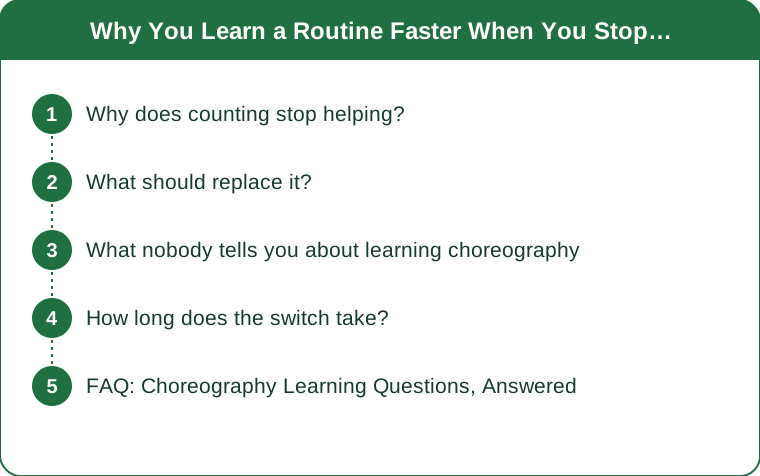
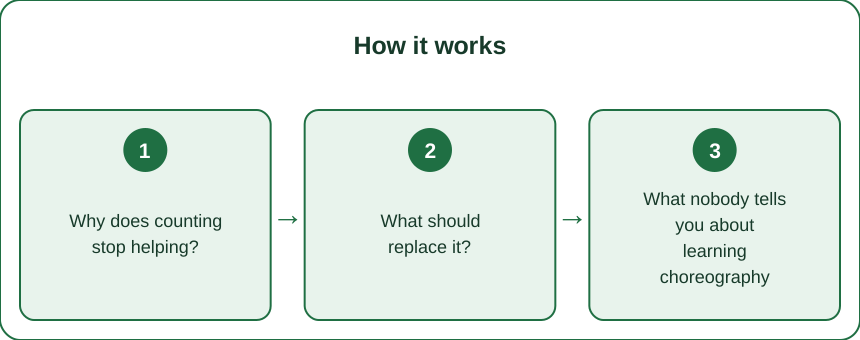
Why does counting stop helping?
Verbal and motor systems compete for attention. Saying numbers occupies the same verbal working memory you would otherwise use for sequencing, and the result is a divided task. Early on the structure is worth the cost; later it is not.
Counting anchors you to the count rather than the music. Movements learned to numbers tend to sit slightly behind the beat, because you are responding to your own count rather than the track.
It blocks the chunking process. Skilled dancers store choreography as a few large chunks, not as 32 separate counts. Counting keeps the material in small units and prevents them merging.
It also breaks under pressure. Counting is the first thing to disappear when you are nervous or out of breath, which is precisely when you need the routine to be automatic.
What should replace it?
Musical landmarks. Identify the three or four moments in the track where something distinctive happens — a snare fill, a vocal entry, a drop — and attach a movement to each. These become retrieval anchors far more robust than counts.
Movement names or sounds. Many teachers use short syllables for movement quality rather than numbers. These occupy less verbal bandwidth and encode the feel of the movement rather than its timing alone.
Phrase-level chunking. Learn eight counts as one shape, not as eight things. Practise the transition into and out of the phrase more than the phrase itself — transitions are where routines actually fall apart.
Silent marking. Running the routine at reduced size without music or counting forces retrieval from memory rather than recognition, which is what builds durable recall.
What nobody tells you about learning choreography
Spacing beats repetition. Three ten-minute practices across three days produce better retention than thirty minutes in one go. This is one of the most consistently replicated findings in motor learning, and almost nobody applies it to dance.
Sleep does a large part of the work. Motor sequences consolidate during sleep, which is why a routine that felt impossible in the evening is often noticeably better the next morning without any extra practice.
Practising to a slightly slower track can hurt. Timing is part of the motor pattern, so learning at 80 percent speed and performing at full speed means partly relearning it. Better to practise short sections at full speed than the whole thing slowly.
Watching yourself in the mirror slows down memorisation. Mirror use shifts attention to visual correction rather than internal feel, which is useful for cleaning and unhelpful for learning. Learn facing away, clean facing in.
And the awkward one: the moment where you lose the routine is almost never the moment where the problem is. Losing it at count 20 usually means the transition at count 16 was never solid.
How long does the switch take?
Give counting the first two or three run-throughs, then drop it. That is usually enough to map the structure.
Expect the first uncounted attempt to be worse. Removing the scaffold reveals what is not yet encoded, which feels like going backwards and is actually the point.
Two or three sessions is the typical adjustment. Most people find that within a week the uncounted version is more reliable than the counted one ever was.
Keep counting available for teaching and for new material. This is not an argument against counting; it is an argument against staying on it.
FAQ: Choreography Learning Questions, Answered
What if the class teaches everything in counts?
Count along in class and practise without counting at home. The class is for acquisition, home practice is for consolidation, and they benefit from different approaches.
I forget the routine completely between classes. Is that normal?
Very. Recognition returns much faster than recall, so a routine you cannot produce from memory often comes back within a minute of the music starting. Retrieval practice — trying to recall it cold — is what closes the gap.
Does learning get harder with age?
Acquisition speed declines modestly, but consolidation and retention hold up well, and experienced movers chunk more efficiently. Practising more often for shorter periods matters more than age does.
TL;DR:
- Counting out loud competes with motor learning for the same working memory.
- Use it for the first two or three run-throughs to map structure, then drop it.
- Replace counts with musical landmarks and phrase-level chunks.
- Space practice across days and sleep on it — both do more than extra repetitions.
- Where you lose the routine is rarely where the problem is; check the transition before it.
Stop counting sooner than feels comfortable. The routine sticks faster without the numbers.
Keep Reading
This article is for general informational and styling purposes only. Fit, sizing, and product availability may vary.