Why You Pick Up Choreography Faster When You Stop Watching Your Feet
Quick Answer: Looking down does three things at once: it shifts your head forward and disrupts your balance, it removes the instructor from your field of view so you fall behind, and it directs your attention to your feet - which are the last thing to move in most choreography. Watching the instructor’s torso and hips instead gives you the timing and the shape earlier, and your feet follow more accurately than they do when you steer them consciously.
Everyone in a first dance class watches their own feet. It feels like the responsible thing to do and it is the single biggest thing slowing you down.
There are three separate mechanisms and all three work against you.

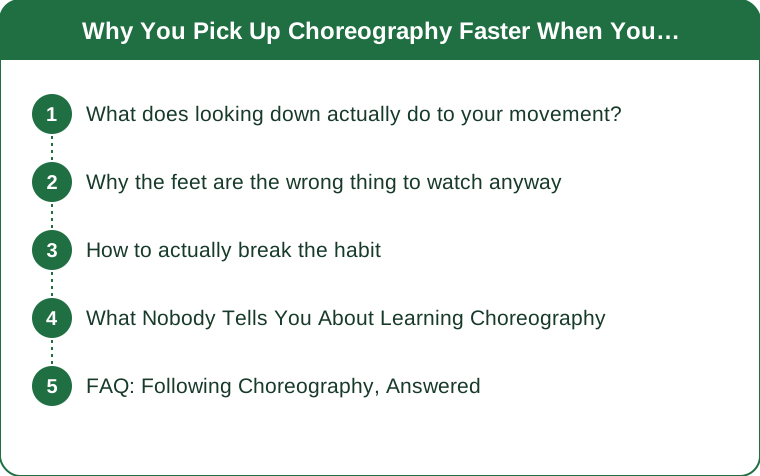
What does looking down actually do to your movement?
Your head weighs a considerable amount and it sits at the top of your balance system. Dropping it forward moves your centre of mass forward, which every other part of you then has to compensate for.
Balance corrections consume attention. Attention spent staying upright is attention not spent learning the sequence, which is why looking down makes learning slower as well as making movement worse.
Your line follows your head. A dropped head produces a rounded spine, a collapsed chest, and shortened arm movements - which is why the same steps look completely different done with the head up.
Peripheral vision does most of the work in group movement, and looking down removes the instructor from your visual field entirely. You then rely on memory and sound alone, half a beat behind.
It also breaks the visual cue chain. In a class you are constantly making micro-corrections from what you see, and looking down means those corrections arrive too late to use.
And it reads as uncertainty, which matters less objectively but affects how you feel in the room - which affects how you move.
Why the feet are the wrong thing to watch anyway
In most choreography the weight shift happens before the step, so the hips tell you what is coming and the feet only confirm what has already been decided.
Watching the instructor’s torso and hips gives you earlier information, which is exactly what you need when you are trying to keep up.
The feet are also the smallest and fastest-moving part, which makes them the hardest thing to read visually at speed across a room.
Your own feet know more than you think. Conscious foot placement is slower than automatic foot placement, and steering them deliberately overrides a system that is better at the job.
This is why people often perform better when they stop trying - a genuinely common experience in dance class that has a real mechanical explanation.
The practical version is to watch the instructor’s midsection and let your peripheral vision handle the rest. It feels wrong for about two classes and then it feels obvious.

How to actually break the habit
Pick a fixed point at eye level and return to it. A spot on the wall, the top of the mirror frame, or the instructor’s shoulders. Having somewhere specific to look is more effective than trying to not look down.
Stand where you can see the instructor without turning, which is usually further back than beginners choose. The front row seems keen and it removes your ability to watch anyone.
Use the mirror for the torso, not the feet. If there is a mirror, check your shape and timing rather than your foot placement.
Learn the arms separately. A large part of looking down is trying to process everything at once. Running the footwork once with no arms, then the arms with a simple step, is faster overall.
Accept getting it wrong at speed. Full-speed wrong is more useful than half-speed correct, because the timing is the part you are actually learning and it does not exist at half speed.
Count out loud, quietly. Counting anchors you to the music rather than to the person in front, which is what stops the half-beat lag from compounding.
And expect it to click on the third repetition, which is the usual pattern. Two run-throughs of confusion followed by a third where it lands is normal, not a sign you are slow.
What Nobody Tells You About Learning Choreography
Everyone in the room is watching themselves, not you. This is genuinely, structurally true in a dance class - the mirror guarantees it - and it is the single most useful thing a nervous beginner can know.
The instructor is not watching your feet either. They are watching timing and energy across the room, which are exactly the things that improve when you stop looking down.
Getting the arms right sells the movement more than getting the feet right. From any distance, upper body shape is what reads, which is the opposite of where beginners put their attention.
Being half a beat behind is a visual problem, not a rhythm problem, almost every time. Fixing where you look fixes it faster than working on your timing.
Your worst run is usually the second. The first is fresh, the second is when you start thinking, and the third is when it becomes automatic. Judging yourself on the second run is judging the low point.
And the confidence effect is not just psychological. Head up genuinely changes your balance, line, and range of motion - so you move better, which makes you feel better, which makes you move better. The loop runs in both directions and you can enter it deliberately.
FAQ: Following Choreography, Answered
Why do I fall behind in dance class?
Usually because you are looking down. That removes the instructor from your visual field, so you lose the constant stream of small visual cues and end up relying on memory half a beat late.
Where should I look instead of my feet?
The instructor’s torso and hips. The weight shift happens before the step, so the midsection tells you what is coming while the feet only confirm what already happened.
Does looking down really affect my balance?
Yes. Your head is heavy and dropping it forward shifts your centre of mass, forcing balance corrections that consume attention you need for learning the sequence.
Should I stand at the front or the back?
Further back than most beginners choose. You need to see the instructor without turning your head, and the front row removes your ability to watch anyone.
How many repetitions before it clicks?
Usually the third. The first is fresh, the second is when you start overthinking, and the third is when it becomes automatic. The second run being the worst is normal.
TL;DR:
- Looking down shifts your centre of mass, consumes attention on balance corrections, and removes the instructor from your field of view.
- Feet are the wrong thing to watch anyway - the weight shift happens in the hips first, so the torso gives you earlier information.
- Pick a fixed point at eye level, stand far enough back to see without turning, and use the mirror for shape rather than foot placement.
- Learn footwork and arms separately, and run it full speed wrong rather than half speed correct.
- The second repetition is usually your worst and the third is when it clicks - do not judge yourself on the low point.
Everyone in the room is watching themselves. That is a fact you can use.
Keep Reading
This article is for general informational and styling purposes only. Fit, sizing, and product availability may vary.