Why Dance Cardio Feels Different When the Evenings Cool Down
Quick Answer: Cooler evenings change dance cardio in two opposite directions at once. Your cardiovascular system works less hard at the same intensity because less blood is diverted to skin cooling, so heart rate at a given effort drops and you can sustain more - which feels great. But muscles and connective tissue take longer to reach working temperature, so the first ten minutes are stiffer, coordination is worse, and the injury risk in fast direction changes is higher. The answer is a longer warm-up and a willingness to push harder in the middle.
The class felt easy in a way it has not since spring. You had more in the tank at the end and you were not soaked through by the third track.
And you also lost the choreography twice in the first ten minutes, which has not happened in months.
Both of those are the same thing.
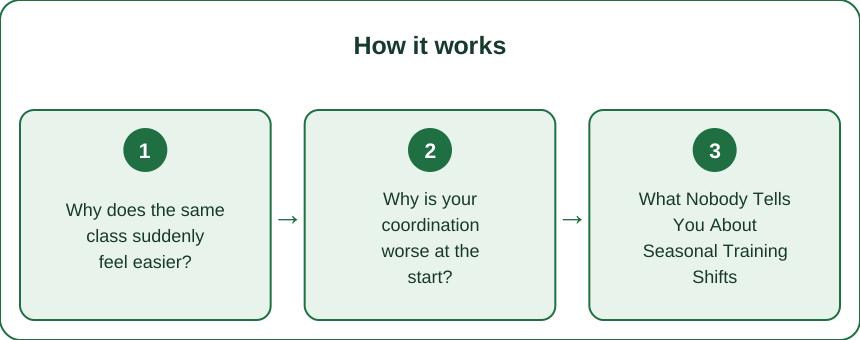
Why does the same class suddenly feel easier?
Because a big share of your cardiovascular capacity was being spent on cooling, and now it is not.
When you exercise in heat, your body diverts a substantial amount of blood flow to the skin to dump heat. That blood is not available to the working muscles, so cardiac output has to rise to serve both - which is why heart rate at any given effort is higher in hot conditions.
This effect is large. Heart rate at the same workload can be meaningfully higher in hot conditions than in cool ones, and the difference is felt directly as perceived effort.
When the evening drops from 85F to 70F, that cooling demand falls sharply. Blood that was going to the skin goes to the legs, heart rate at the same intensity drops, and you can hold a higher output for longer.
There is also a plasma volume component. A summer of heat training expands plasma volume as an adaptation, and that expanded volume is still there for a few weeks after the heat goes. So you get the benefit of the adaptation without the cost of the conditions.
This is a genuine performance window and it does not last. Late August into September is when a lot of people set personal bests, because summer training has adapted them and the conditions have improved. Use it.
Why is your coordination worse at the start?
Because muscle and connective tissue temperature drives both stiffness and neural speed, and both are lower now.
Muscle contracts faster and more forcefully when it is warm. Nerve conduction velocity is also temperature dependent - signals genuinely travel faster in warm tissue. Cool muscle is slower to contract, slower to relax, and slower to respond to a change of plan.
Dance cardio is unusually dependent on all three, because it involves rapid direction changes, quick weight transfers and continuous adjustment to a beat. That is a coordination-heavy demand, not just a cardiovascular one.
In July, the ambient temperature was doing a large part of your warm-up before you arrived. In late August, arriving at a 68F studio from a 65F evening, you are starting genuinely cold, and the first two tracks are being danced by a body that is not ready.
This is where injury risk sits. Ankle and knee injuries in dance cluster in the first section of a session and in rapid direction changes, and cold tissue is less tolerant of both.
The fix is not complicated but it does require actually doing it: ten to fifteen minutes of progressive warm-up rather than the three minutes that was sufficient in July. Start with general movement, add range, then add speed, then add direction change. Speed and direction change last - those are the demands that need the most warmth.
What Nobody Tells You About Seasonal Training Shifts
Your heart rate zones are not fixed numbers. If you train to heart rate targets, the same zone represents a genuinely different effort in cool conditions than in hot. Hitting your usual zone in cooler weather requires working harder, which is either the point or a problem depending on whether you know it is happening.
The evening energy shift is real and it is about light. Late August evening light drops fast, and light exposure drives alertness through melatonin suppression. An 8pm class in July happens in daylight; the same class in late August happens in near-dark, and people commonly report lower energy without connecting it to the light. Bright studio lighting genuinely helps.
Sweat rate drops before thirst does. You will sweat less in cooler conditions and feel less thirsty, but the fluid you lost over a hot summer is not automatically replaced, and mild chronic dehydration is common in late August. Coordination and reaction time are affected by dehydration before endurance is.
Your shoes have had a summer. Dance and cross-training shoes lose midsole cushioning and lateral support over months of use, and late August is when a spring purchase is worn. Lateral support failure shows up as ankle instability in exactly the direction changes that cool tissue already handles worse.
Learning happens better in the second half of a session. Once warm, motor learning and retention improve. If a class front-loads new choreography, expect to struggle with it in cool weather and to pick it up better on the repeat later in the class.
How should you adjust?
Longer warm-up, harder middle, and use the window.
Warm up for ten to fifteen minutes, progressively. General movement first - marching, easy travel, arm swings. Then dynamic range - leg swings, hip circles, torso rotations. Then speed - quick feet, small jumps. Then direction change - lateral shuffles, pivots. In that order. Going straight to fast footwork on cold tissue is where the ankles go.
Then push harder in the working section than you did in July. Your cooling system is not competing for blood flow, and you have carried a summer’s plasma volume adaptation into better conditions. This is the best training window of the year and most people coast through it because the sessions feel easier and they read easier as done.
Dress in two layers and take one off. Arriving in one thin layer means the first fifteen minutes are spent warming up rather than training. A layer that comes off after the warm-up does exactly the right thing.
Keep drinking as if it were July for another few weeks. The thirst signal drops faster than the deficit clears.
And check your shoes. If they have been through a summer of classes, look at the lateral upper for creasing and the midsole for compression. This is the cheapest injury prevention available and the most commonly skipped.
FAQ: Cooler Weather Dance Cardio Questions, Answered
Should I expect my heart rate to be lower for the same class?
Yes, and that is a real physiological effect rather than a measurement error. Less blood is being diverted to the skin for cooling, so cardiac output serves the muscles more efficiently. If you train to zones, you will need to work harder to reach the same zone.
How long does the summer adaptation last into autumn?
Plasma volume expansion from heat training begins to reverse within a couple of weeks of the heat ending, and most of the benefit is gone within a few weeks. That is why late August into early September is a genuine window rather than a permanent improvement.
Why do I lose choreography more in the first tracks now?
Cool muscle contracts and relaxes more slowly and nerve conduction is slower in cool tissue, so the whole coordination system is running behind. It resolves as you warm, which is why the same sequence that fell apart in track two is fine in track six. A longer warm-up largely removes the problem.
TL;DR:
- Cool air frees up the blood flow that was going to skin cooling - heart rate drops at the same effort and you can do more.
- A summer’s plasma volume adaptation is still there for a few weeks, which makes late August a genuine performance window.
- Cool tissue is slower to contract and slower to respond, which is why coordination fails in the first ten minutes.
- Warm up progressively for 10 to 15 minutes: general, then range, then speed, then direction change.
- Push harder in the middle - easier sessions are the trap of this month.
- Check your shoes - lateral support that has been through a summer is where ankles go in cool-weather direction changes.
The class did not get easier. Your body stopped spending half its capacity on staying cool.
Keep Reading
This article is for general informational and styling purposes only. Fit, sizing, and product availability may vary.