Dance Fitness When You Genuinely Can't Follow Choreography: A Real Strategy, Not Just 'Keep Trying'
Quick Answer: Following choreography isn’t the same skill as being coordinated or fit — it’s sequential memory plus real-time visual processing, and those vary between people independently of everything else. That’s why “just keep coming to class” often doesn’t work: live class trains the skill under maximum pressure. The fix is to train it separately, with slowed-down tutorial video at home, while using live class for the workout rather than the accuracy.
You can do every single move in the class. Individually. Slowly. Perfectly.
Put eight of them in a row at 128 BPM and your brain files for an extension.
That’s not a coordination problem. It’s a completely different skill, and nobody ever tells you it’s separate.
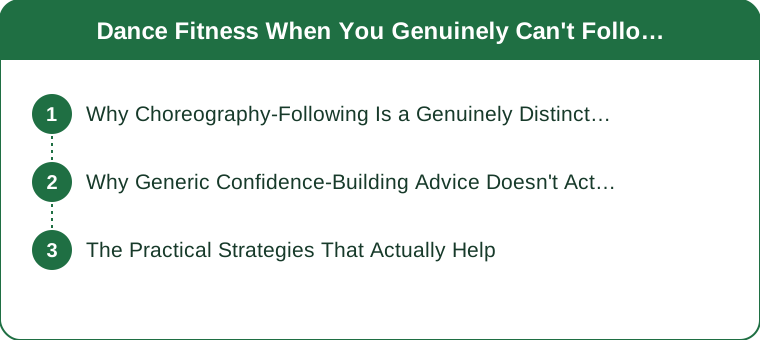
Why Is Following Choreography Its Own Skill?
Three separate abilities get bundled under “can dance,” and you can be strong at some and weak at others.
Executing one move ≠ recalling a sequence. Physically performing a grapevine correctly is a motor task. Remembering that the grapevine comes after the hip roll and before the turn, at speed, is a memory task. Different cognitive jobs entirely. You can be excellent at the first and struggling badly at the second.
Sequential working memory varies between people. How much ordered information you can hold and recall on the fly differs meaningfully person to person, and it’s independent of your fitness or your general movement coordination. Someone who lifts heavy, runs well, and has excellent body awareness can still find an 8-count sequence genuinely hard to retain. That isn’t a contradiction.
Visual processing speed is its own trainable thing. Watching an instructor and immediately translating what you see into your own body — mirrored, at tempo — is a specific skill. It gets faster with practice, and it doesn’t come free with general dance experience.
So “you’ll get it eventually” isn’t wrong, exactly. It’s just aimed at whichever of these three you happen to be missing, without knowing which one.
Why Doesn’t the Usual Advice Work?
“Just relax and have fun” treats a skill gap as a nerves problem. Confidence advice assumes what’s stopping you is self-consciousness. Sometimes it is. But if the actual barrier is sequential recall speed, feeling more relaxed doesn’t add memory capacity. You’ll be calmly unable to follow the sequence.
“Keep coming to class” trains the skill at maximum difficulty. This is the bigger issue. A live class runs at full tempo with no repetition, no rewind, and a room full of people. That’s the hardest possible condition to build a new skill in. Attending forty of them without any other approach mostly means experiencing the same frustration forty times.
Nobody would try to learn a piano piece by only ever playing it at full speed. Yet that’s exactly the default advice here.
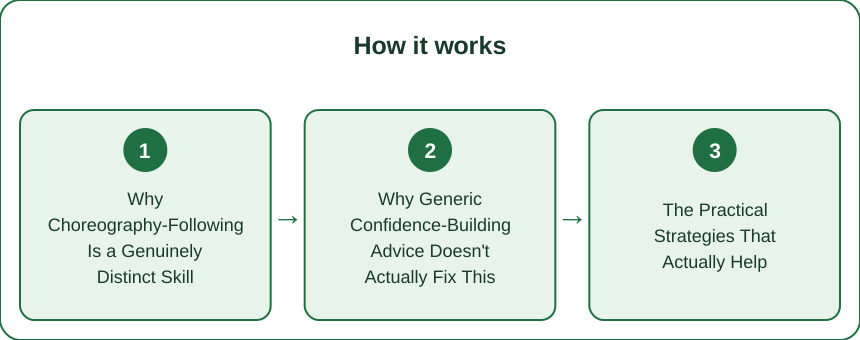
What Actually Trains the Skill?
Practice with slowed-down video at home. This is the highest-leverage change and it’s the one almost nobody makes. Find a tutorial for a routine, drop the playback to 0.5x or 0.75x, and run the sequence until you can do it without watching. Fifteen minutes, three times a week. You’re isolating the sequence-memory skill and training it without real-time pressure — the exact thing live class can’t give you. Then when you meet a similar pattern in class, you already have it.
Position yourself with a clear view of experienced participants. Back or side of the room, behind someone who clearly knows the routine. You get a second reference alongside the instructor, and crucially one that isn’t mirrored, which removes a whole category of left-right confusion. Use them as your lag indicator — half a beat behind is fine.
Make continuous movement the actual in-class goal. Set the accuracy target aside during live class and keep the effort target. You still get the full cardio and mood benefit from moving continuously at tempo, whether or not the footwork matches. Live class becomes your workout; home practice becomes your skill training. Trying to make one session do both jobs is why it feels like neither is working.
Learn the instructor’s vocabulary, not the routines. Most instructors reuse a limited set of building blocks across every routine they teach. Learn eight of those cold and a huge share of any new routine becomes recognizable rather than novel. That’s why sticking with one instructor pays off so much faster than sampling widely.
Mini FAQ
How long before this actually improves?
With slowed-down home practice two or three times a week, most people notice a real difference in 4–6 weeks. Without it, improvement from live class alone is much slower and some people plateau indefinitely.
Is there anything wrong with me if this is hard?
No. Sequential working memory varies naturally across people, and this particular demand — memorize, mirror, and execute simultaneously at tempo — is genuinely difficult. Plenty of physically capable, well-coordinated people find it hard.
Should I tell the instructor?
Yes, briefly, before class. Good instructors will cue more verbally and break sequences down further when they know someone needs it. Many will also point you at a tutorial video for their routines, which is exactly what you want.
TL;DR:
- Choreography-following is sequential memory plus visual processing — distinct from fitness or coordination.
- Live class is the hardest condition to learn in; attending more of them alone often doesn’t build the skill.
- Train it separately: slowed-down tutorial video at home, 15 min, 3x a week.
- In class, stand behind an experienced participant for an unmirrored reference.
- Make continuous movement the in-class goal and let home practice handle accuracy.
Keep Reading
This article is for general informational and styling purposes only. Fit, sizing, and product availability may vary.