Why You're Always a Half-Beat Behind in Dance Cardio
Quick Answer: Feeling a half-beat behind usually means you’re watching the instructor and translating before moving, adding a processing delay. Counting out loud and anchoring to the beat instead of the visual closes that gap faster than any amount of extra practice.
You can see the move coming, you know what’s next, and somehow your body still arrives at the count a fraction of a second after everyone else’s.
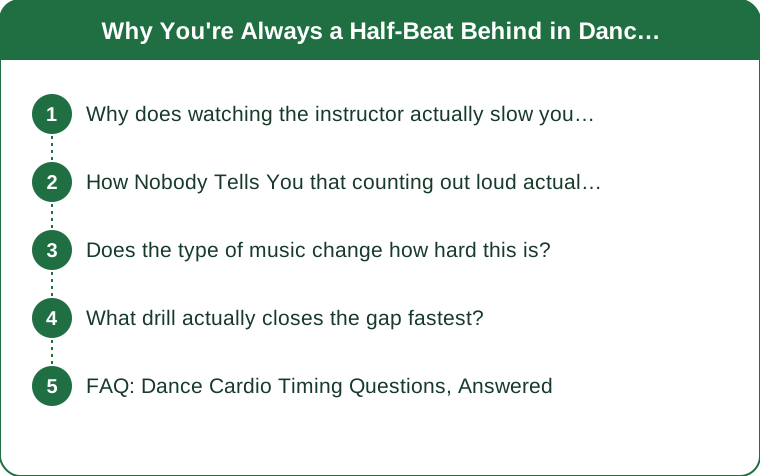
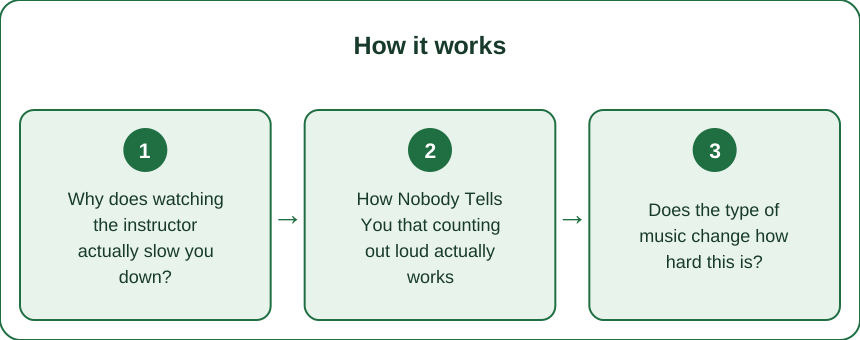
Why does watching the instructor actually slow you down?
Visual processing takes longer than auditory processing for most people — your brain has to see the move, interpret it, then send the signal to your muscles, which adds a small but real lag. Listening for the beat and counting engages a faster, more automatic response pathway than visual mimicry alone.
How Nobody Tells You that counting out loud actually works
Silently counting in your head is easy to lose under exertion and loud music, but counting out loud (even just mouthing ‘5, 6, 7, 8’) forces your brain to commit to the rhythm in real time rather than react to it. Instructors who count loudly aren’t just being encouraging — they’re giving you an anchor to sync to directly instead of through the delay of watching them move.

Does the type of music change how hard this is?
Songs with a strong, consistent backbeat (most pop and hip-hop dance tracks) are easier to lock onto than syncopated or slower ballad-style tracks where the beat is less obvious. If you’re consistently behind on one style of class but fine in another, it may be the music’s rhythmic clarity rather than your timing itself.
What drill actually closes the gap fastest?
Practice the 8-count with just your feet stepping in place to the beat, no arms, no choreography — purely locking your body clock to the music before adding complexity back in. Layering choreography onto shaky timing just practices being off-beat with extra steps attached.
FAQ: Dance Cardio Timing Questions, Answered
Is being behind the beat a coordination problem?
Not usually — it’s more often a timing-anchor problem (watching instead of listening) than a true coordination deficit, and it responds well to the drills above rather than requiring broader coordination training.
Will this improve on its own with more classes?
Some improvement happens naturally, but actively counting out loud and doing beat-only step drills speeds it up significantly compared to just attending more classes passively.
Does it matter if I’m in the back of the room?
Being farther from the instructor increases reliance on sound over sight, which can actually help timing once you adjust — front-row dancers sometimes lean too hard on visual mimicry.
TL;DR:
- Watching-then-moving adds a processing lag that shows up as being behind the beat
- Counting out loud anchors your body to sound instead of sight
- Some songs are simply harder to lock onto than others
- A feet-only, no-choreography beat drill rebuilds timing fastest
The half-beat-behind feeling is a fixable timing habit, not a sign you’re not cut out for dance cardio.
Keep Reading
This article is for general informational and styling purposes only. Fit, sizing, and product availability may vary.