Sore After Dance Cardio? How to Tell Normal Soreness From Overdoing It
Quick Answer: Mild to moderate soreness that peaks 24-48 hours after class and fades within 3 days is normal delayed-onset muscle soreness (DOMS). Sharp joint pain, soreness lasting over 5 days, or pain during normal walking are signs you overdid it or picked up a minor injury.
You taught your legs a hundred new directional changes last night and today you’re waddling to the coffee maker. Before you decide whether to skip the next class or push through, here’s how to actually read what your body is telling you.

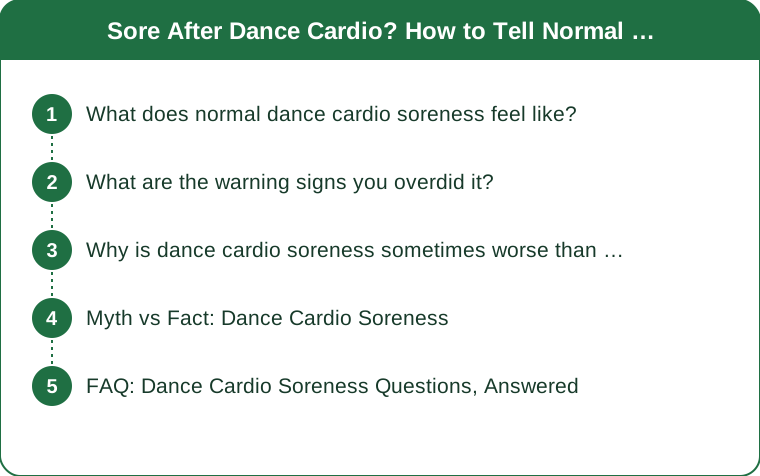
What does normal dance cardio soreness feel like?
Diffuse, achy, and symmetric — both quads, both calves, roughly equal soreness on each side. It typically peaks 24-48 hours after class (that’s DOMS, delayed-onset muscle soreness) and noticeably improves by day 3.
It should feel like a dull ache that loosens up as you move — walking up stairs might be uncomfortable at first but gets easier within the first few steps, not worse.
What are the warning signs you overdid it?
Watch for these three flags:
- Sharp or localized pain in a specific joint (knee, ankle) rather than diffuse muscle soreness
- Soreness lasting more than 5 days without improvement
- Pain that gets worse with movement instead of loosening up, or swelling around a joint
Any of these suggest something beyond normal muscle adaptation — possibly a minor strain or overuse issue that deserves rest and, if it persists past a week, a professional opinion.

Why is dance cardio soreness sometimes worse than running or lifting?
Dance cardio hits muscles through multi-directional, eccentric-heavy movement — lateral steps, quick direction changes, controlled lowering — that running’s mostly forward motion doesn’t train. New dancers especially feel this because their stabilizer muscles (inner thighs, ankles, glute medius) haven’t adapted to constant direction changes yet.
This is also why the soreness fades faster with consistency: by week 3-4 of regular classes, most people report noticeably less next-day soreness even at the same intensity, because those stabilizers have caught up.
Myth vs Fact: Dance Cardio Soreness
Myth: No soreness means the workout didn’t work. Fact: Soreness measures novelty, not effectiveness. A dancer with 2 years of experience can have a brutal, effective class with almost no next-day soreness because their body has adapted to the movement patterns.
Myth: You should push through soreness at full intensity the next class. Fact: Training through DOMS at full intensity increases injury risk since sore, fatigued stabilizers don’t fire as precisely. Lower-impact movement (walking, gentle stretching) speeds recovery better than another hard session.
Myth: Stretching after class prevents all soreness. Fact: Stretching helps mobility and feels good, but DOMS is a muscle-fiber-level response that stretching alone doesn’t eliminate — hydration, protein intake, and gradual intensity buildup matter more.
FAQ: Dance Cardio Soreness Questions, Answered
How soon can I take another dance cardio class if I’m sore?
If soreness is mild-to-moderate and improving, 48 hours is usually enough. If it’s severe or worsening, wait for clear improvement first.
Does staying hydrated actually reduce soreness?
It supports muscle recovery generally, though it won’t eliminate DOMS from a genuinely new movement pattern. Combined with light movement and protein, it modestly speeds the timeline.
When should I see a doctor instead of just resting?
If pain is sharp, localized to a joint, accompanied by swelling, or hasn’t improved at all after 5-7 days, get it checked. This is general information, not medical advice.
TL;DR:
- Diffuse, symmetric soreness peaking at 24-48 hours and fading by day 3 is normal DOMS
- Sharp joint pain, swelling, or soreness past 5 days are red flags — rest and consider a professional
- Soreness fades with consistency as stabilizer muscles adapt, usually by week 3-4
- Light movement beats a hard second session at fixing lingering soreness
Read your body’s signal, not just the ache — diffuse and fading is a good workout; sharp and worsening is a warning.
Keep Reading
This article is for general informational and styling purposes only. Fit, sizing, and product availability may vary.