Bad at Following Dance Cardio Routines? Here's How Coordination Actually Improves
Quick Answer: Feeling uncoordinated in dance cardio is a skill-acquisition stage, not a fixed trait — most people need 4-6 classes of the same instructor’s style before choreography starts clicking. Watching feet less and the instructor’s overall shape more speeds that process up.
You’re not the only one two counts behind in the back row. Coordination in dance cardio is a trainable pattern-recognition skill, and almost everyone starts exactly where you are.
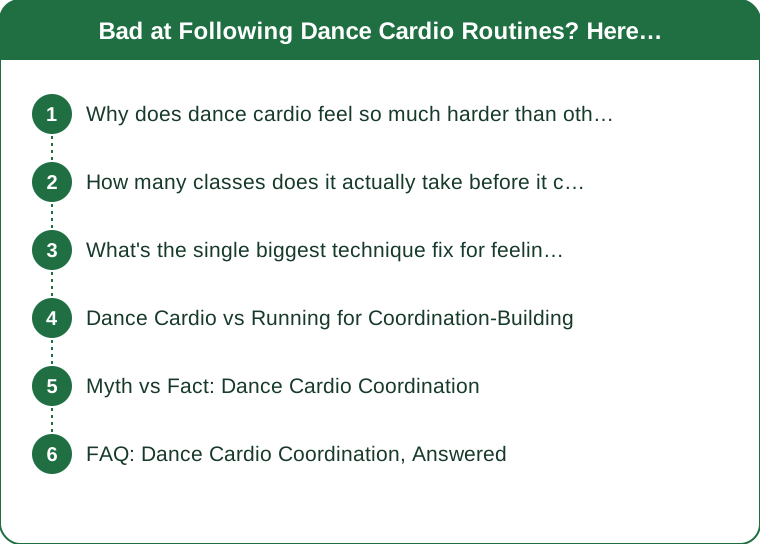
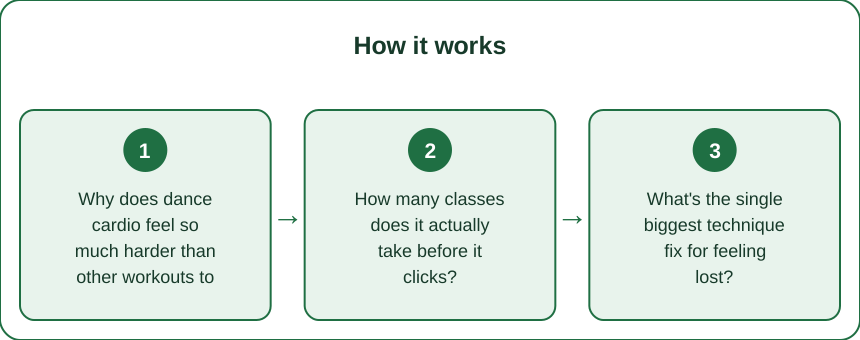
Why does dance cardio feel so much harder than other workouts to follow?
Because it demands simultaneous rhythm-tracking, spatial memory, and movement execution — three cognitive tasks other workout formats rarely combine at once. A squat or a bicep curl only asks your body to execute; a dance routine asks you to predict what comes next while executing the current move.
This is why people who are otherwise very fit can feel surprisingly lost in their first few dance cardio classes — it’s a different skill, not a fitness deficit.
How many classes does it actually take before it clicks?
Most instructors and dedicated dance-fitness students report a 4-6 class threshold with the same instructor before choreography patterns start feeling predictable. This is because many instructors reuse phrase structures and signature transitions across classes — your brain is learning their specific choreographic ‘vocabulary,’ not starting from zero each time.
Switching instructors or formats frequently resets some of this progress, which is why sticking with one instructor for your first month accelerates the learning curve noticeably.
What’s the single biggest technique fix for feeling lost?
Watch the instructor’s torso and arms, not their feet. Beginners instinctively stare at feet for footwork cues, but feet move fastest and least predictably — the torso telegraphs direction and weight shift earlier and more clearly. Shifting your visual focus up the body is one of the fastest fixes for feeling perpetually one step behind.
Dance Cardio vs Running for Coordination-Building
Running builds cardiovascular fitness efficiently but does nothing for the pattern-recognition and rhythm skills dance cardio develops. Conversely, dance cardio’s coordination demands mean beginners sometimes get a lower-intensity workout than intended in early classes, simply because so much mental energy goes to figuring out the steps rather than moving at full effort.
Both are valid — but if coordination is your specific goal, dance cardio is training exactly that skill, and the cardiovascular benefit compounds as choreography becomes automatic.
Myth vs Fact: Dance Cardio Coordination
Myth: Some people are just born uncoordinated and can’t improve. Fact: Rhythm and movement-pattern recognition are trainable skills with consistent practice — dancers aren’t a fixed category of person, they’re people with more repetitions logged.
Myth: You need to nail every step to get a good workout. Fact: Simplified versions of the same movement (smaller range, half-time footwork) still deliver real cardiovascular benefit while your coordination catches up.
Myth: The back row is where beginners give up trying. Fact: The back row is often the smartest place to learn — more room to make mistakes, sightline to copy nearby dancers, less self-consciousness.
FAQ: Dance Cardio Coordination, Answered
Should I look in the mirror or at the instructor?
The instructor, primarily — mirrors can reverse your sense of left and right, which adds confusion rather than clarity early on.
Is it OK to simplify steps I can’t keep up with?
Yes — marching in place through a fast footwork section while keeping the arm movements is a completely legitimate modification that still delivers workout benefit.
Will taking multiple different class styles slow my progress?
Somewhat — sticking with one instructor or format for your first month builds pattern recognition faster than sampling many styles at once.
TL;DR:
- Coordination in dance cardio is trainable, not fixed — most people need 4-6 classes to feel it click
- Watch the instructor’s torso and arms, not their feet, for earlier movement cues
- Simplifying steps while keeping the rhythm still delivers real cardio benefit
- Stick with one instructor for your first month to build pattern recognition faster
Give one instructor’s style 4-6 classes before judging your coordination — most people are shocked how much clicks by class five.
Keep Reading
This article is for general informational and styling purposes only. Fit, sizing, and product availability may vary.