Dance Cardio in an Apartment Without Enraging the People Below You
Quick Answer: Apartment noise from dance cardio comes from impact transmitted through the floor structure, not from volume in the air. The fixes are landing softly on the whole foot, keeping both feet closer to the floor, adding a thick mat or rug, moving away from the middle of the room, and choosing low-impact choreography. You can keep almost all the intensity — arms, speed, and range of motion cost your neighbors nothing.
You got the note. Or the ceiling knock. Or you have been doing your workout in a state of low-grade guilt for months.
The good news is that the parts of dance cardio that annoy people below are not the parts that make it work.
What actually travels downstairs?
Impact vibration through the floor structure, not airborne sound. This distinction decides every fix.
When your heel strikes the floor, the impulse travels into the joists and radiates as sound in the room below. It arrives as a thud rather than as music, which is why neighbors describe it as banging even when your speaker is quiet.
Low frequencies travel best through structure. A heel drop produces exactly the low-frequency impulse that concrete and wood transmit most efficiently. Your speaker is almost never the problem unless the bass is genuinely loud.
Where you stand matters a lot. The middle of a floor span flexes most and transmits most. Near a load-bearing wall, the floor barely moves, and the same jump can be dramatically quieter three feet away.
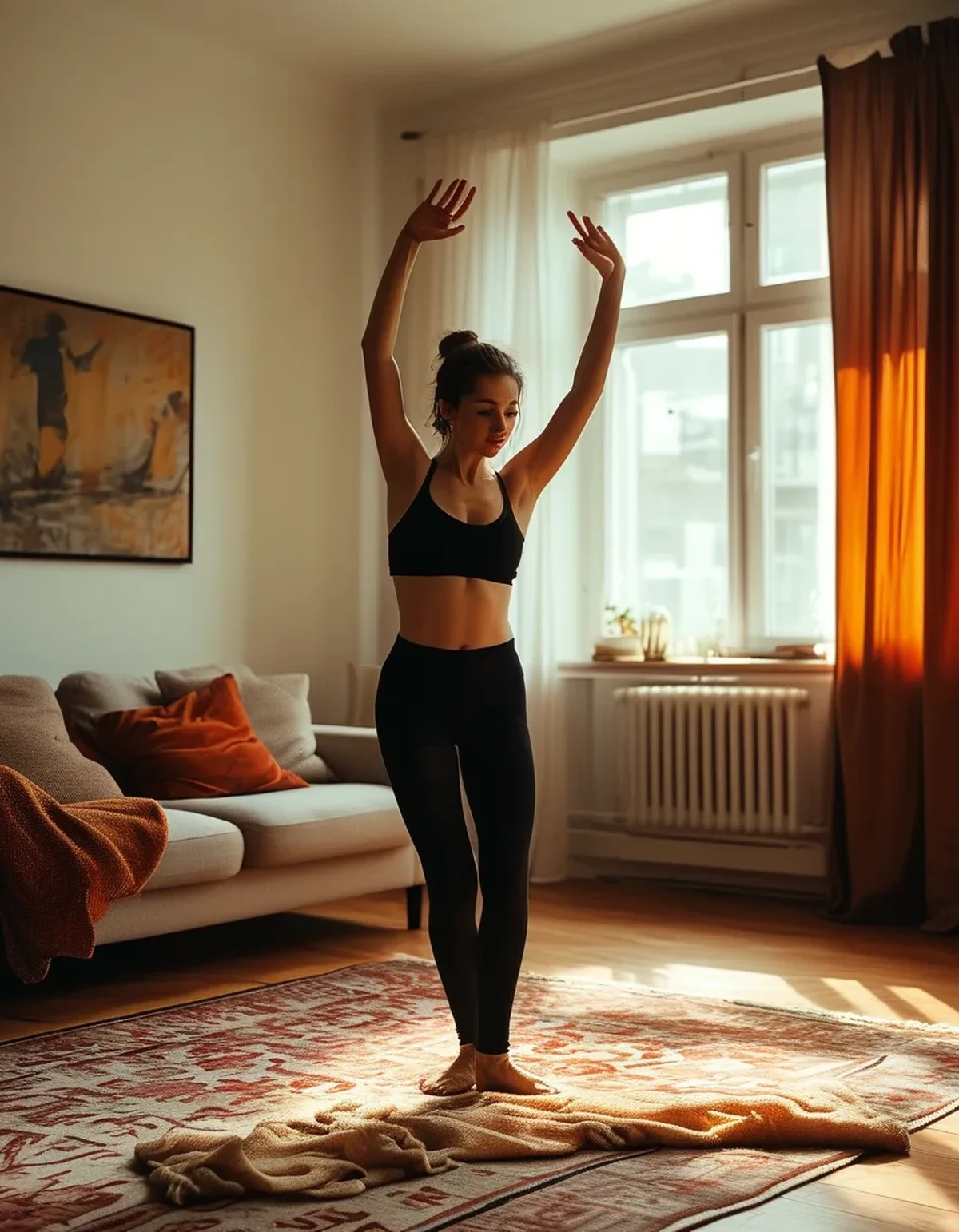
What does not travel: arm movements, torso work, fast footwork that stays light, and anything where both feet are not leaving and returning to the floor hard. This is most of what makes dance cardio effective, which is the whole opportunity here.
The six changes that work
1. Land on the whole foot, not the heel. Absorb through the ball of the foot first and let the heel come down softly. This alone cuts impact noise substantially and it is a better landing pattern for your joints regardless.
2. Keep at least one foot down. Convert jumps to steps. A jumping jack becomes a step-out jack; a jump squat becomes a fast bodyweight squat. The heart rate barely changes and the noise disappears.
3. Bend your knees more. Soft knees absorb force that stiff legs transmit into the floor. This is the most under-appreciated single fix and it costs nothing.
4. Put something under you. A thick exercise mat, a rug with a dense pad, or interlocking foam tiles. Density matters more than thickness — a thin dense mat outperforms a thick soft one. A rug on its own does surprisingly little without a pad beneath it.
5. Move to the edge of the room. Near a wall, especially a load-bearing one. The floor deflects far less there, and this is free.
6. Time it reasonably. Not before 8am, not after 9pm. Most complaints are about timing rather than volume, and a workout at 6pm is a completely different social situation than the same workout at 10:30pm.
What you keep: speed, arm work, range of motion, choreography complexity, and the music. Everything that makes it a workout survives these changes.
Myth vs Fact: Quiet Home Workouts
Myth: A yoga mat solves it. Fact: A 4mm yoga mat is designed for grip and cushioning, not for vibration isolation. You need a dense 15mm-plus mat or interlocking foam tiles to meaningfully change what reaches downstairs.
Myth: Low impact means low intensity. Fact: Heart rate is driven by muscle work and movement speed, not by whether your feet leave the ground. A fast low-impact dance routine easily reaches the same heart rate zones as a jumping one.
Myth: Carpet is enough. Fact: Carpet absorbs airborne sound and does very little for structural impact. The pad underneath does more than the carpet, and most apartment carpet padding is thin.
Myth: It is only a problem in old buildings. Fact: Modern lightweight construction with wood joists often transmits impact worse than older concrete construction. Building age is a poor predictor of how much your neighbor hears.
Myth: If they have not complained, it is fine. Fact: Most people never complain and are quietly irritated for months. Assume some transmission is happening if you do any impact work at all.
What does a low-impact dance workout actually look like?
Warm-up: 5 minutes of marching, step-touches, shoulder rolls, and hip circles. Same as always.
Working section: 20 to 30 minutes built from grounded moves. Step-touch, grapevine, hip sways, body rolls, arm-driven combinations, low squats and lunges with dance transitions. Speed and arms carry the intensity.
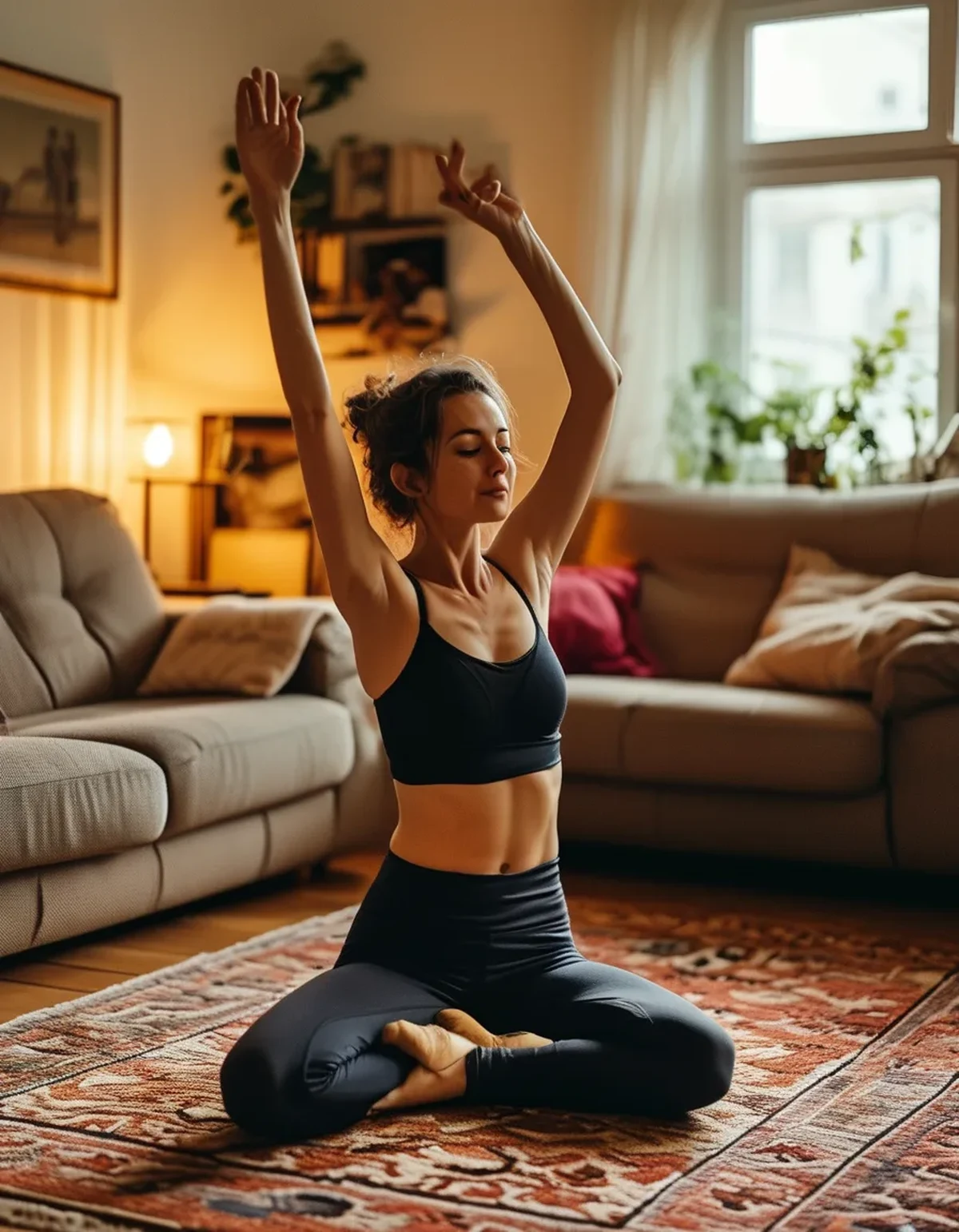
The intensity levers that cost nothing: move your arms above your head more often, increase the tempo, deepen your knee bend, and reduce rest between sequences. Arms overhead raise heart rate meaningfully and produce zero floor impact.
Add hand weights carefully. One to three pounds is plenty for dance work, and heavier weights change your shoulder mechanics badly at speed.
Cool down: 5 minutes of slow movement and stretching.
How to find routines: search for low impact dance cardio, apartment friendly workout, or quiet HIIT. Many instructors now explicitly offer low-impact versions of their routines, and modification cues are common in classes aimed at joint-friendly training.
If a routine you love has jumps: substitute in real time rather than skipping the routine. Every jump has a grounded equivalent, and you will get better at spotting them within a few sessions.
FAQ: Apartment Workout Questions, Answered
Will foam tiles really make a difference?
Yes, if they are dense and you use enough of them. A 2x2 metre area of 20mm high-density interlocking tiles noticeably reduces what transmits. Cheap soft foam compresses fully on impact and does much less.
Should I talk to my neighbor first?
It usually helps more than any equipment. Telling someone you exercise at 6pm for half an hour and asking them to tell you if it is a problem converts a mystery noise into a known one, and known noise bothers people far less.
Is walking in place a real workout?
Brisk marching with arm movement is genuine moderate cardio, especially sustained for 30 minutes. It is not the same as a hard interval session, and it is far better than the workout you skip because of the neighbors.
What about a treadmill or bike instead?
A bike is close to silent structurally and is an excellent apartment option. A treadmill transmits considerable impact and vibration and generally needs a dedicated mat plus a good location to be neighbor-friendly.
TL;DR: It is impact through the floor, not volume in the air.
- Land whole-foot with soft knees. The biggest free reduction available.
- Keep one foot down. Every jump has a grounded equivalent at the same heart rate.
- Dense mat or interlocking tiles, not a yoga mat and not a rug alone. Density beats thickness.
- Move to the edge of the room, near a load-bearing wall. The floor barely deflects there.
- Arms overhead and faster tempo raise intensity at zero cost to your neighbors.
- Timing causes more complaints than volume. Between 8am and 9pm changes the whole situation.
Try one session this week with soft knees and no jumps, and notice your heart rate is exactly where it always was.
Keep Reading
This article is for general informational and styling purposes only. Fit, sizing, and product availability may vary.